If you constantly think about your body, avoid mirrors, overanalyze photos, compare yourself to other women, or feel like your mood changes depending on how you look that day, you are not alone.
A lot of women think body image struggles are just about insecurity or wanting to “look better.” But in therapy, we often discover something much deeper underneath it.
For many women, body image becomes tied to self-worth, loneliness, identity, and emotional safety.
And in today’s world, that struggle is getting worse.
Why Am I Constantly Thinking About My Body?
One of the most common questions women ask is:
“Why am I obsessing over my body all the time?”
The answer is not because you are shallow or self-centered.
We live in a culture that constantly teaches women that being desirable, attractive, young, thin, or “put together” is connected to being worthy, loved, accepted, successful, and important.
Your body stops feeling like a body.
It becomes:
- a project
- a measurement of worth
- a source of control
- a way to avoid rejection
- a way to feel “enough”
Many women spend enormous amounts of mental energy:
- checking mirrors
- comparing themselves online
- monitoring food
- overthinking photos
- worrying about aging
- trying to fix flaws
- thinking about how they are perceived
Eventually, body image stops being about appearance.
It becomes emotional survival.
The Part No One Talks About: Body Image and Loneliness
One of the biggest hidden costs of body image struggles is loneliness.
A lot of women become so focused on fixing themselves physically that they slowly disconnect from themselves emotionally.
You may notice:
- avoiding social situations because you feel insecure
- canceling plans after feeling bad about your appearance
- feeling disconnected during intimacy or relationships
- struggling to feel present because you are hyper-aware of your body
- believing you will finally feel confident “once you lose weight” or “fix yourself”
Meanwhile, life keeps moving.
Research has shown that body dissatisfaction is linked to anxiety, shame, low self-esteem, emotional distress, and social withdrawal. Many women become trapped in cycles of self-monitoring and comparison that quietly consume their emotional energy.
This matters even more during a time when loneliness is already increasing worldwide.
We are more connected digitally than ever before, yet many women feel deeply disconnected from themselves, their relationships, and their sense of identity outside appearance.
How Loneliness Can Fuel Body Image Struggles
Body image struggles are not always caused by appearance alone.
Sometimes the obsession with appearance grows stronger during periods of loneliness, disconnection, rejection, heartbreak, or feeling emotionally lost.
When people feel disconnected from themselves or others, the mind often searches for something concrete to control.
For many women, that becomes the body.
You may notice body image getting worse when:
- you feel lonely or isolated
- your relationships feel emotionally unfulfilling
- you are struggling with dating or rejection
- you feel disconnected from your identity
- you lack deeper emotional connection or purpose
- your self-worth feels unstable
In therapy, many women realize:
“I thought my body was the problem… but I actually felt alone.”
Body image can both create loneliness and be driven by loneliness.
The more consumed someone becomes with appearance, the more emotionally disconnected they often feel:
- avoiding photos or social events
- withdrawing from relationships
- struggling to be emotionally present
- comparing themselves constantly
- feeling “not good enough” around others
Over time, life can become smaller.
This is why healing body image is not just about changing thoughts about appearance.
It is also about rebuilding connection:
- connection to yourself
- connection to your identity
- connection to relationships
- connection to a life that feels meaningful outside appearance
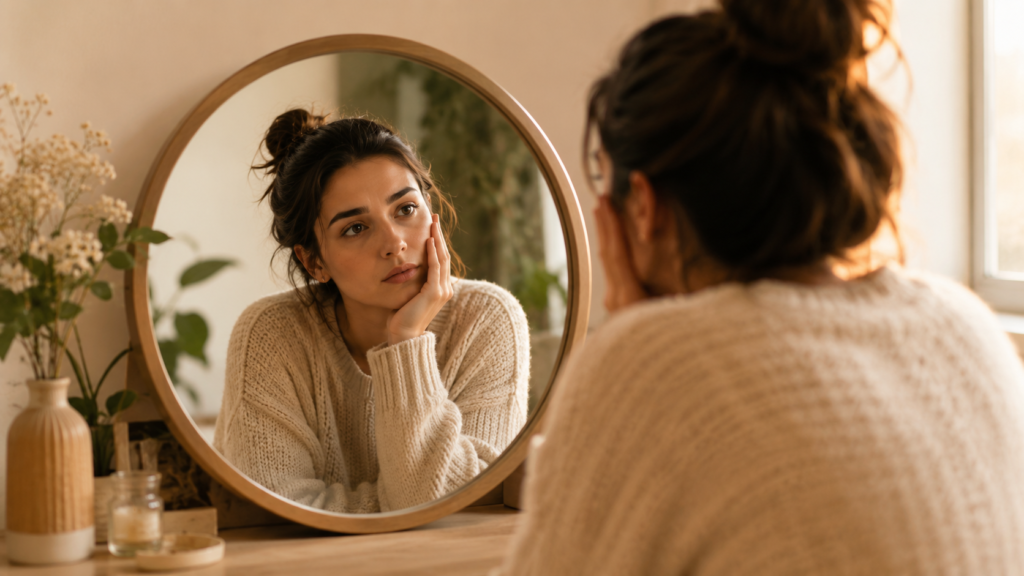
Why Do I Hate Looking at Myself in the Mirror?
Another common question women search is:
“Why do I hate looking at myself in the mirror?”
For many people, mirrors become emotionally loaded.
You are not just seeing your reflection.
You are seeing:
- comparison
- self-criticism
- fear of judgment
- fear of aging
- shame
- pressure to meet impossible standards
Sometimes women become so focused on appearance that they lose connection to who they are outside of how they look.
In therapy, we often explore:
- Who are you outside appearance?
- What gives your life meaning?
- What relationships are being neglected?
- What emotions are underneath the body obsession?
- What happens if your worth is no longer tied to being desirable?
These questions can feel uncomfortable, but they are often where healing begins.
Signs Body Image Is Affecting Your Mental Health
Body image struggles are not always obvious.
Sometimes they look like:
- constantly checking mirrors or photos
- avoiding mirrors completely
- comparing yourself to other women
- feeling anxious before social events
- obsessing over aging or flaws
- feeling emotionally unstable based on appearance
- difficulty enjoying intimacy or relationships
- believing confidence only comes after changing your body
- spending excessive time thinking about food, weight, or appearance
Many women normalize these behaviors because they are so common.
But common does not mean healthy.
Healing Body Image Is About More Than Appearance
Healing body image is not about forcing yourself to “love your body” every second.
It is about creating a life where your body is no longer the center of your emotional world.
In therapy, women often learn how to:
- reduce obsessive body thoughts
- stop constant comparison and checking
- build self-worth outside appearance
- process shame and insecurity
- reconnect with identity beyond desirability
- feel emotionally grounded even when their body changes
- create deeper relationships and connection
The goal is not perfection.
The goal is freedom.
Body Image Therapy in Fairfax, VA
At Blooming Minds Counseling, we help women struggling with body image, anxiety, self-worth, overthinking, perfectionism, and identity concerns.
Many of our clients are high-functioning women who logically know their worth is deeper than appearance, but still feel trapped in cycles of self-criticism, comparison, and body anxiety.
We offer in-person group and individual therapy in Fairfax and virtual therapy across Virginia, DC and MD.
If you are tired of feeling consumed by thoughts about your body, therapy can help you reconnect with yourself in a deeper and more meaningful way.